
Pillar guide
The Zero-Chaos Client Lifecycle: Onboarding, Reporting, Approvals, Handoffs and Offboarding
A practical playbook for every stage of an agency client relationship, with the steps, failure points and templates that keep clients happy and work moving.

Clients rarely leave because of one big failure. They leave after a run of small ones: slow onboarding, a report that arrives late, an approval that went to the wrong person, a handoff that lost context. Each stage of the client lifecycle has predictable failure points, and each can be removed with a clear procedure. This guide covers the five stages — onboarding, reporting, approvals, internal handoffs and offboarding — with the steps, the issues we see most, and how to run them from one library.
01
Onboarding: the first 14 days decide the relationship
The biggest onboarding issue is chasing access. Ad accounts, analytics, CMS logins and brand assets trickle in for weeks, and the client feels nothing is happening.
Fix it with a single kickoff checklist sent before the first call, a named client approver, and a 'first win' delivered inside two weeks.
- 1Send the access-and-assets request within 24 hours of signature.
- 2Confirm one primary approver and one backup on the client side.
- 3Hold kickoff: goals, KPIs, reporting cadence, communication channel.
- 4Log everything in the client record before work starts.
- 5Deliver and announce one visible quick win by day 14.
Access request email
Hi [Name], to start on [date] we need:
• Admin access to [analytics / ad accounts / CMS]
• Brand files: logo, fonts, colours, guidelines
• Your primary approver and a backup
Reply with anything that needs a call and we'll book 15 minutes.
02
Reporting: consistent, on time, and explained
Late or inconsistent reports erode trust faster than poor results. The fix is a reporting SOP with a fixed date, fixed structure, and a short written summary — numbers alone don't explain anything.
Common failures: wrong date ranges, metrics changing month to month, and no 'what we'll do next'. Put each of these in the verification step.
- Fixed send date (e.g. 5th business day of the month).
- Same KPIs every month, agreed at kickoff.
- Three-sentence summary: what happened, why, what's next.
- QA by a second person: date range, client name, links.
03
Creative approvals: one approver, clear rounds
Approval chaos comes from unclear decision rights. When three people on the client side give conflicting feedback, your team loses days reconciling it.
Your approval SOP should define the approver, the number of included revision rounds, the feedback format, and what happens when feedback is late.
Before
- • Feedback via email, WhatsApp and calls
- • Unlimited rounds
- • Approval from 'whoever replied'
After
- • One consolidated feedback document
- • Two included rounds, then a change request
- • Written approval from the named approver
04
Internal handoffs: don't lose the context
Handoffs between sales and delivery, or between account managers, lose the most valuable information: what the client cares about and what was promised.
A handoff SOP forces the important parts into writing: goals, promises, risks, personalities, open tasks. The receiving person confirms they've read it before the client meeting.
Handoff template
Client:
What they bought / what was promised:
Their top 3 goals:
Known risks or sensitivities:
Key contacts and preferences:
Open tasks and deadlines:
Where the files are:
05
Offboarding: leave the door open
Offboarding is often skipped because it feels like a loss. Done well, it protects your reputation, removes security risk and frequently brings clients back.
- 1Confirm end date and final deliverables in writing.
- 2Hand over files, logins and documentation the client owns.
- 3Remove your team's access to client systems and record it.
- 4Ask for a short exit conversation and honest feedback.
- 5Schedule a friendly check-in in 3–6 months.
06
Running the whole lifecycle from one place
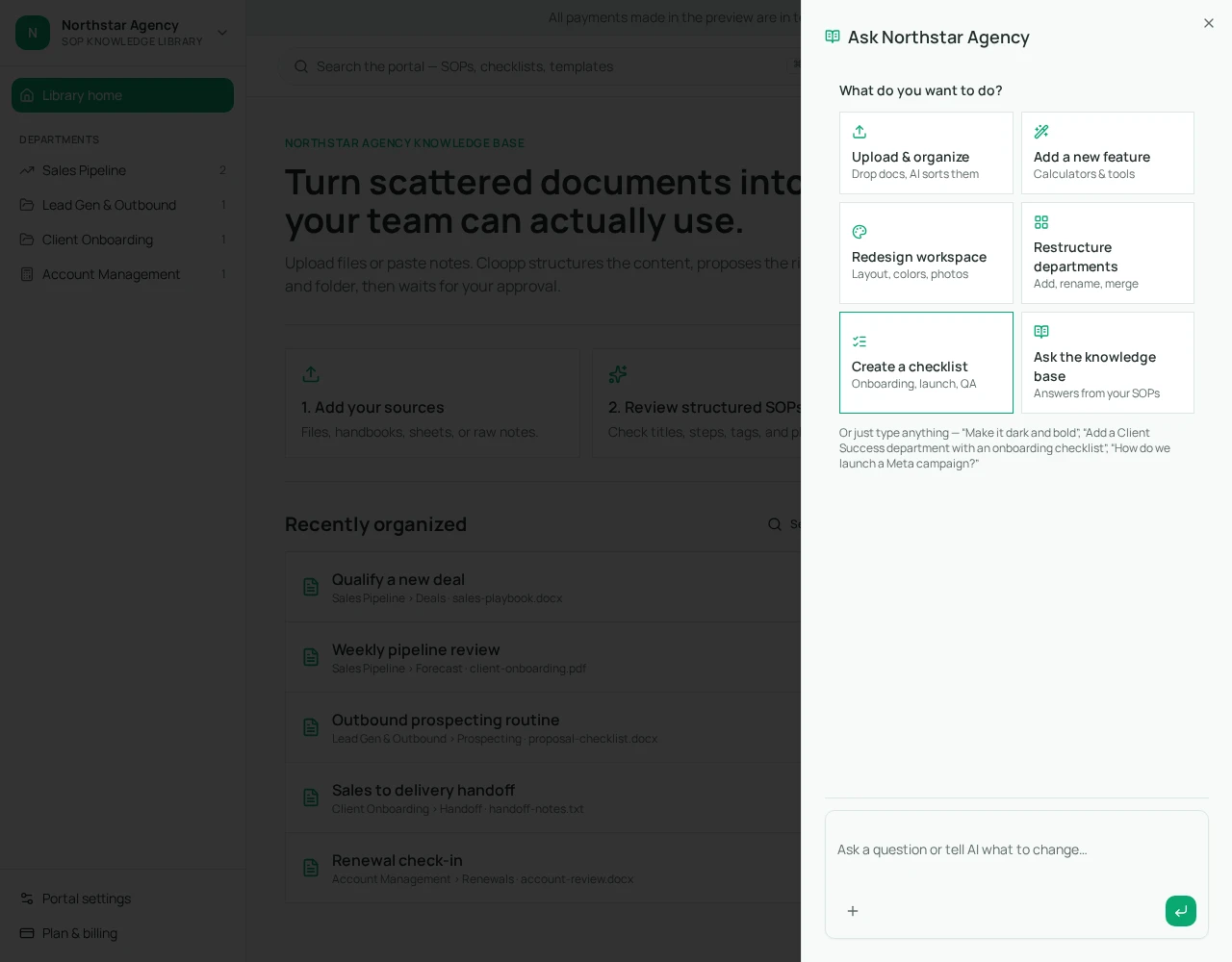
Each of these procedures lives in Cloopp's Client Services department. Account managers search 'handoff' or 'offboarding' and get the approved version. Ask AI can answer questions using your own SOPs, and the client CRM widget keeps contacts and approvers in the same workspace.
If you want clients themselves to see part of this — onboarding steps or brand guidelines — give them their own workspace with member (read-only) access. They see only that workspace and can't edit anything.
Frequently asked questions
- How many revision rounds should an agency include?
- Two is common for creative work. What matters most is that the number is written down and agreed before work starts.
- Can clients see our SOPs?
- Only if you invite them. Workspaces are private, and you choose exactly which workspaces a person can access, with read-only member access for clients.
Put it into practice
Get the client lifecycle templates
Start with ready-made onboarding, reporting, approval and offboarding SOPs, then adapt them to how your agency works.
Explore free templates