
Knowledge management
How to Run an SOP Library Search Acceptance Test
Test real queries, scope, approval status, and ambiguous results before launching a knowledge library. Includes a copy-ready worksheet and troubleshooting steps.

Your team has approved thirty procedures and arranged them into neat departments. That is not yet evidence that a new teammate can find the right one. A search acceptance test checks the reader’s route to an answer: the words they type, the workspace they are in, the result they recognize, and the instructions they ultimately use. It is a lightweight manual test you can run before rollout and after major imports—not an analytics feature you need to buy or an AI promise that every synonym will work.
01
Define success from the reader’s perspective
Choose representative tasks rather than testing only exact titles. “Where do I request ad access?” is a real need; copying the full procedure title into search proves little about findability. Include a known title query, a task phrase, a platform keyword, and a question whose answer is intentionally outside this workspace.
Success means the person identifies the correct current procedure and can explain its scope. A long list of loosely relevant results is not enough. Agree on your own practical target, such as finding a known answer within a minute, and measure it manually; do not present that local target as a product performance guarantee.
Search acceptance worksheet
Query | Workspace | Expected procedure | Result found? | Reader confusion | Fix
ad account access | Agency Ops | Request Google Ads account access | [Y/N] | [note] | [action]
monthly report | Client Success | Send monthly report | [Y/N] | [note] | [action]
old client pricing | Client A | No private pricing result | [Y/N] | [note] | [action]
Tester: [ordinary member]
Date / retest: [dates]
02
Step 1: Gather the queries people actually use
Take ten recent process questions from your approved team communication channels and remove confidential details. Ask two colleagues how they would search for each answer. Preserve their short phrases rather than replacing them with the documentation owner’s preferred taxonomy.
Include at least one ambiguous phrase. “Launch” could mean a campaign, website, or onboarding milestone. The expected result should either be distinguishable by its title and summary or prompt the reader to add the missing qualifier. You are testing both retrieval and recognition, not demanding that search guess unstated intent.
- 1Choose ten recurring tasks or questions from recent work.
- 2Name the current approved SOP expected for each.
- 3Ask a reader to supply a natural search phrase without seeing the title.
- 4Add ambiguous and out-of-scope queries to the test list.
- 5Record the intended workspace and account role for each test.
03
Step 2: Run the test in the real Cloopp workspace
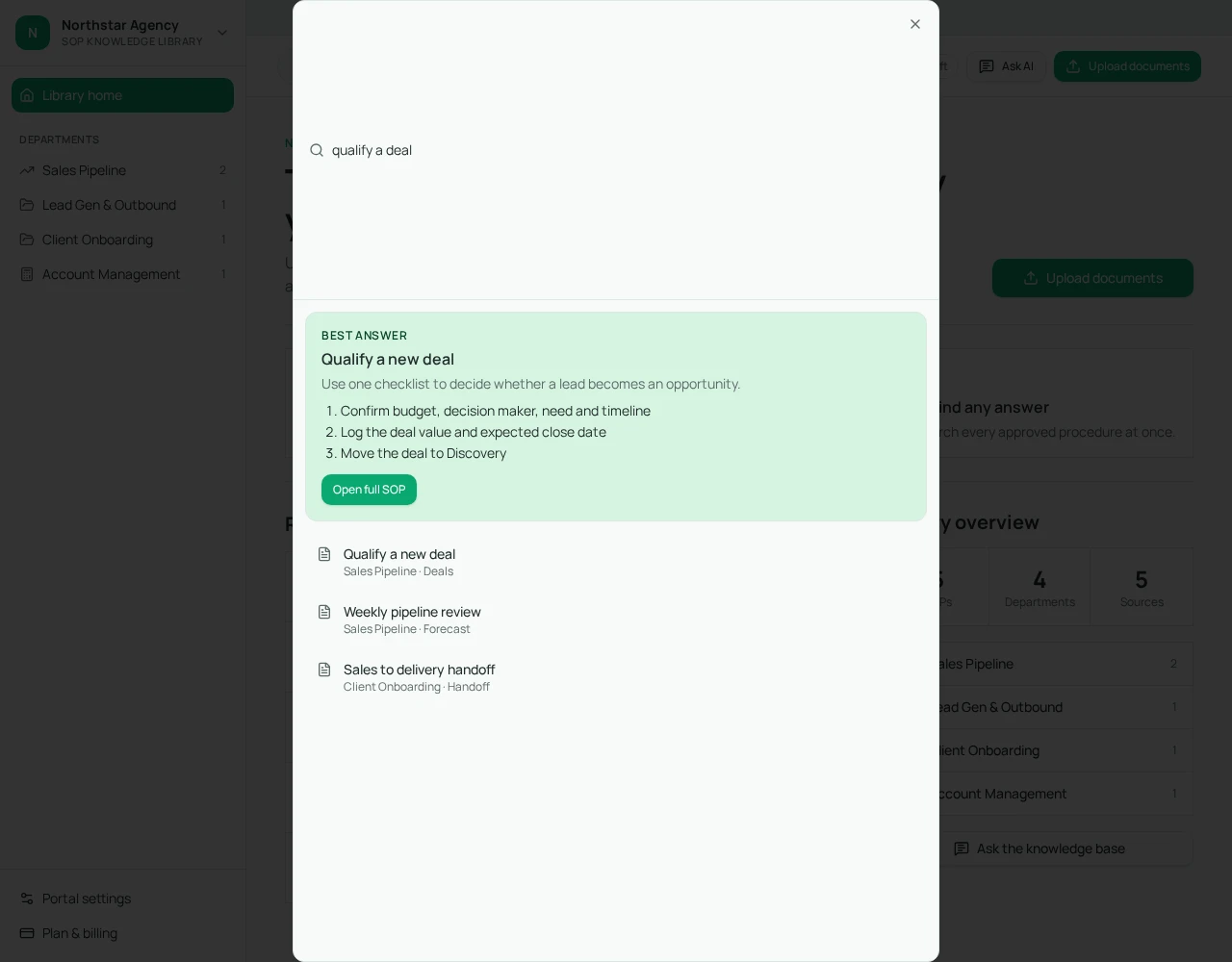
Sign in with an authorized ordinary-member account and confirm the workspace name. Use the main search bar to test each phrase, open the candidate SOP, and ask whether its objective matches the intended task. Search in this workflow is scoped to the current workspace’s approved library.
For recently imported material, confirm approval before testing. A procedure still waiting in the review flow is not a failed search result; it is not yet in the approved library. Distinguish content readiness from retrieval problems so your fixes target the actual cause.
Before
- • Owner searches exact titles
- • Any result counted as success
- • Drafts mistaken for missing published content
After
- • Member uses natural task phrases
- • Correct scope checked after opening
- • Approval and workspace confirmed first
04
Step 3: Fix the smallest source of confusion
If the right result has an unclear title, rename it with a task verb and useful qualifier. If two results look interchangeable, clarify their objectives and audience. If the language differs from the team’s vocabulary, add accurate everyday wording in the title or summary rather than stuffing irrelevant keywords into the page.
If an expected SOP does not exist, record a content gap. Ask the process owner to draft it from actual knowledge and approve it before retesting. Do not ask AI to manufacture a company policy simply so every test query produces an answer. A clear “we do not have this procedure yet” is safer than a confident but unsupported instruction.
- 1Check workspace, membership, and approval state before changing content.
- 2Clarify the title and summary of confusing procedures using Edit SOP.
- 3Separate genuinely different tasks with explicit scope boundaries.
- 4Draft missing knowledge from a real source and review it.
- 5Repeat the original query list and record whether the fixes worked.
05
Troubleshooting and a repeatable release check
If exact title fragments still fail, inspect the saved title and test from the current workspace after the content update completes. Capture the query and expected procedure for support if the problem persists. Do not claim that stemming, fuzzy matching, or every synonym is guaranteed; test the phrases your people need.
If Ask AI answers differently from the procedure, open its sources and verify the current instructions. Free search and AI-assisted answers serve different purposes. Use search for a direct findability test rather than consuming credits to see whether the assistant can compensate for confusing names.
Repeat the worksheet after large uploads, structural template changes, and major renaming. Keep the list small enough for a lead to rerun. Compare the same tasks over time, and add a new query when a real teammate gets stuck. A useful library earns trust through repeated successful retrieval, not through its total document count.
Frequently asked questions
- Does Cloopp provide this acceptance-test worksheet automatically?
- No. This is a manual quality check using the product’s normal search and reader experience.
- Should every query return a result?
- No. Out-of-scope and undocumented tasks should not produce misleading answers. Verify that expected knowledge is present and approved, and record genuine content gaps.
Put it into practice
Test your library before announcing it
Give a teammate ten real queries, watch where they hesitate, and fix the names or instructions that block the answer.
Explore free templates