
Client operations
Sales-to-Delivery Handoffs: Check the Promise Before Kickoff
Reconcile scope, deadlines, assumptions, and approvals before the delivery team meets a new client. Includes a promise register and accurate Cloopp SOP steps.

Sales remembers a monthly strategy call. Delivery plans for a quarterly review. The client expects weekly access to the strategist because it was mentioned during discovery. Each team holds a different version of the promise, and kickoff is where the conflict becomes visible. A pre-kickoff promise check compares the signed agreement with the operational assumptions before anybody commits resources. Cloopp can document that repeatable check; it does not automatically interpret contracts or convert a CRM deal into enforceable delivery tasks.
01
Separate agreed scope from conversational possibility
Collect the signed agreement, approved proposal, and relevant discovery notes. Identify statements about deliverables, frequency, dates, dependencies, exclusions, and client responsibilities. Classify each as agreed, conditional, or unresolved. A suggestion discussed during sales is not automatically part of the final scope.
Have the accountable sales or account lead resolve discrepancies using your company’s commercial process. The delivery team should not interpret unclear terms alone, and an AI summary should not become the authority for what the client purchased. For consequential contract interpretation, obtain appropriate professional review rather than relying on a process article.
02
Step 1: Build a small promise register
List only the promises that change delivery decisions. “Friendly service” may describe tone; “two review rounds within the monthly fee” changes resource planning. Write the source and responsible owner beside each material statement so a disagreement can be resolved without another search through email.
For a fictional SEO engagement, note audit timing, reporting frequency, content quantities, implementation responsibility, and required client access. If the proposal assumes the client’s developer implements fixes, make that dependency visible. Otherwise the delivery team may promise completed technical changes it is not staffed or authorized to make.
Promise register
Promise | Source | Delivery implication | Status | Owner
Monthly report | Signed agreement | Prepare by [date] | Confirmed | Account lead
Technical fixes | Proposal assumption | Client developer implements | Needs confirmation | Sales lead
Review rounds | Agreement | [number] included | Confirmed | Project lead
Access by kickoff | Client dependency | Audit start depends on access | Open | Account lead
Resolve before: [kickoff date]
03
Step 2: Document the repeatable check in Cloopp
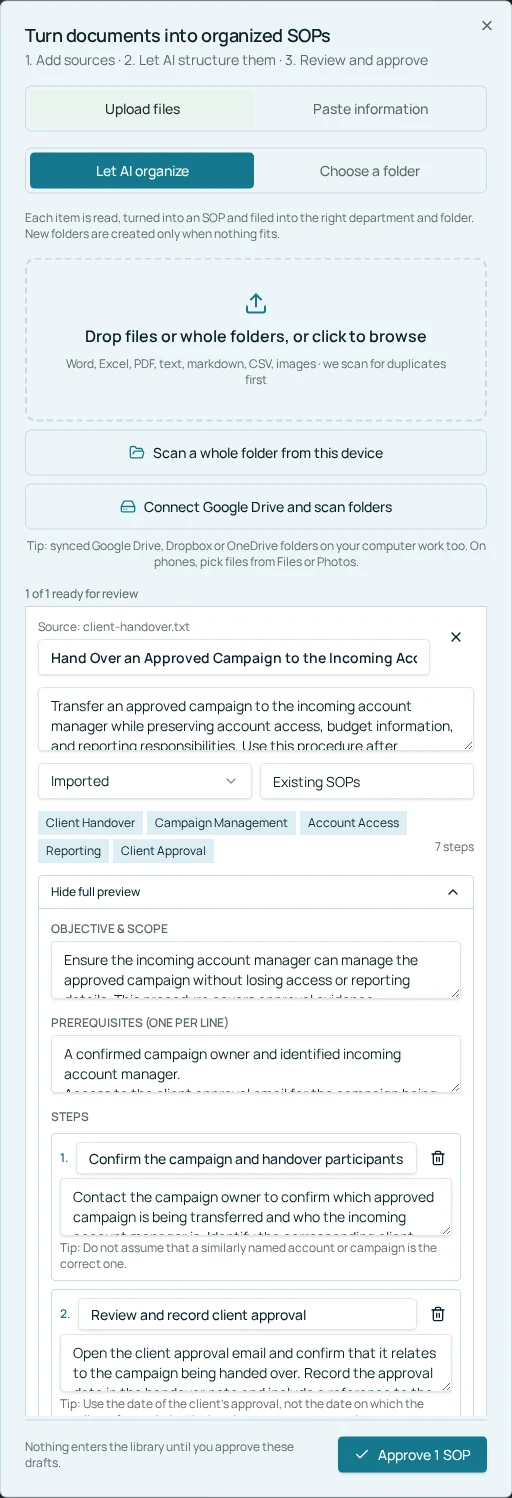
Write a procedure titled “Confirm sales promises before client kickoff.” Its prerequisites should name the necessary sources and roles. The steps should compare terms, identify dependencies, review delivery capacity, resolve discrepancies, and prepare the confirmed kickoff brief.
Use a sanitized version of your actual handoff notes in the upload or pasted-information draft flow. In Preview & edit full SOP, inspect the title, objective, steps, and verification. Remove automatic CRM actions or invented commercial rules that the AI may suggest. Approval publishes the checked procedure, not the client’s signed agreement or an automated deal workflow.
- 1Gather the signed scope and approved sales notes in the authorized project system.
- 2Draft the handoff checks using the company’s real roles and decision route.
- 3Import the process notes and open Preview & edit full SOP.
- 4Verify instructions and place the SOP in the appropriate department and folder.
- 5Approve, then run the check for one upcoming kickoff.
04
Step 3: Have delivery read back the plan
Ask the delivery lead to explain the scope, first milestone, dependencies, and communication cadence in their own words. This reveals assumptions that a document alone may not surface. Sales then confirms or corrects those points before the account team communicates them to the client.
Record unresolved decisions with an owner and date. A kickoff can still occur while one detail is open, but the uncertainty must be explicit and the meeting must not silently convert it into a promise. Use the SOP’s verification checks to confirm that the operating brief matches the resolved agreement.
Before
- • Sales and delivery recall different terms
- • Kickoff reveals missing dependencies
- • Team absorbs unplanned work
After
- • Material promises linked to sources
- • Delivery reads back the operating plan
- • Uncertainty resolved through a named commercial owner
05
Troubleshooting conflicting sources and changing expectations
If a proposal and signed agreement differ, ask the commercial owner which governs and document the resolved instruction. Do not select whichever source is easiest for delivery. If the client recalls an additional promise, acknowledge the concern and use the agreed resolution route rather than arguing from an incomplete handoff.
If resource capacity does not match the timeline, escalate before kickoff with concrete options: change the milestone, reduce the initial scope, or add resources with authorization. Cloopp records the process; staffing and commercial approvals are still made by your team in its normal systems.
After the first month, compare delivery questions with the handoff record. If the same assumptions recur, add one targeted prerequisite or verification check. The purpose is not to make sales complete a huge form. It is to prevent the few misunderstandings that create the largest client disappointment.
Frequently asked questions
- Does the CRM widget automatically run this handoff?
- No automatic sales-to-delivery workflow is claimed here. Use the SOP to guide a deliberate manual check and keep deal records in the appropriate system.
- Can AI decide what our contract promises?
- No. AI can help structure supplied notes, but an authorized person must verify and resolve commercial terms.
Put it into practice
Check the promise before the next kickoff
Document the material commitments, have delivery read them back, and resolve one ambiguity before it reaches the client.
Explore free templates