
Agency operations
Knowledge Transfer Before an Employee Leaves: A Tested Handover Plan
Capture recurring decisions, turn notes into reviewed procedures, test them with a successor, and separate knowledge handover from account and ownership changes.

A departing operations lead hands over a folder of documents. Two weeks later, the team discovers that nobody knows when to override the staffing plan or which client needs an unusual approval. Files moved; judgment did not. A successful knowledge transfer captures triggers, decisions, dependencies, and examples, then tests whether the successor can use them. This plan uses Cloopp to structure and approve the instructions while keeping account ownership, credentials, and external access in their proper processes.
01
Prioritize the work that stops without this person
Begin with the last month of recurring work, not a request to “document everything you know.” Identify tasks only the departing employee performs, decisions they make without prompting, and deadlines that fall soon after departure. A weekly resource-planning decision may be more urgent than an old reference presentation.
For each task, name the successor, the next occurrence, the inputs, and the consequence of a missed decision. Rank those with near-term deadlines or financial and client risk first. Keep personal opinions about colleagues out of the library; capture operational preferences and approvals in factual, appropriate terms.
Handover inventory
Task / decision: [weekly resource allocation]
Next occurrence: [date]
Successor: [role]
Inputs and locations: [approved links]
Decision rule: [when to rebalance]
Exceptions: [conditions needing approval]
Practice example: [sanitized recent case]
Reviewer and completion date: [role / date]
02
Step 1: Capture decisions through a real walkthrough
Ask the departing employee to demonstrate one recent task and explain why they chose each action. “How do you know this request is ready?” often reveals more than “What are the steps?” Capture tool locations, prerequisite approvals, common exceptions, and the expected final result.
Use sanitized examples rather than copying confidential client conversations wholesale. Store original business records where company policy requires them. Do not put passwords, recovery codes, or private personal data into SOP text. Use your approved credential manager and access-administration process for secrets and permissions.
- 1List recurring and high-risk tasks with the successor and departure date.
- 2Walk through a recent representative example together.
- 3Capture decision rules and exception signals in plain language.
- 4Ask what the successor should verify before calling the task complete.
- 5Check that the notes contain no secrets or unnecessary sensitive information.
03
Step 2: Turn the notes into reviewed Cloopp procedures
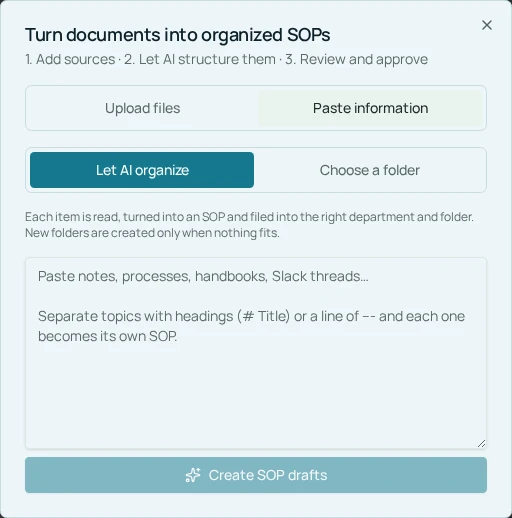
In the correct workspace, use Upload documents → Paste information for captured notes or upload a source document. Supply one coherent process at a time so an AI draft does not blend resource planning, billing, and client escalation into one broad procedure. Review the proposed title and placement before looking at the detailed steps.
Open Preview & edit full SOP and have both the departing employee and successor examine the draft. Remove invented contacts and thresholds, confirm the objective and prerequisites, and add verification and exception detail. Only approved imported drafts enter the shared library. Manual Start blank is different: it adds an initial SOP immediately, so use the draft flow when incomplete content must remain out of the team library.
04
Step 3: Run a successor-led test before departure
The successor should perform a low-risk example from the approved instructions while the current owner observes. Reverse the usual shadowing arrangement: the learner does the work and the experienced person only intervenes when necessary. Record every missing input or unexplained decision and update the SOP before the next attempt.
For resource planning, the practice might use a sanitized week with one overallocated specialist and one client deadline. The successor explains the proposed change, approval needed, and communication plan. This is a manual competence check; reading an SOP or checking its steps does not automatically establish that the handover is complete.
Before
- • A folder transferred on the last day
- • Successor watches but never performs
- • Exceptions remain in private memory
After
- • Reviewed procedures for priority work
- • Successor completes a representative example
- • Decision rules and escalation are explicit
05
Troubleshooting ownership, access, and unfinished work
If the departing person is the only administrator available, arrange another appropriate administrator in Team access before they leave. An Admin role is not the same as transferring billing or workspace ownership. Do not promise that promoting a colleague changes the owner account; unresolved ownership changes need support and deliberate planning.
If time is short, prioritize the next recurring task and document known unknowns. Label open questions in the handover notes and name who will resolve them. Approving a polished AI draft while its decision rules are uncertain only hides the gap. Let the successor know which instructions were actually tested and which still require supervision.
On the agreed date, remove memberships where appropriate and separately update external tool access, credential ownership, billing contacts, and recovery methods. Verify the successor can reach the necessary resources under their own account. Knowledge transfer is finished when the person, instructions, and access all support the next real task—not when the departing employee sends a farewell email.
Frequently asked questions
- Can an admin take over an owner’s billing account?
- An administrator can curate workspace content, but promotion does not itself transfer account ownership or billing. Arrange those changes separately and contact support if needed.
- What if the employee leaves before everything is documented?
- Prioritize upcoming and high-risk work, record unresolved decisions honestly, and supervise the successor while those gaps are closed.
Put it into practice
Test the handover before the last day
Capture one critical decision, approve the procedure, and ask the successor to complete an example with it.
Explore free templates